
Hair Dryer Quality Control
BAILE controls hair dryer quality from incoming components and approved samples through assembly, electrical safety testing, performance verification, aging, packaging, and outgoing inspection. The quality system covers brushed and brushless motor dryers, salon models, travel dryers, wall-mounted units, pet dryers, kids dryers, straightening dryers, and styling appliances. Documented control points help maintain product safety, functional consistency, visual standards, packaging accuracy, and batch traceability across OEM and ODM production. Each order follows the confirmed model, target market, and inspection plan.
- IQC control for motors, heating assemblies, PCB boards, cords, plugs, molded parts, and packaging
- First article approval and IPQC checks during injection, decoration, assembly, testing, and packing
- Airspeed, airflow, outlet temperature, noise, electrical safety, aging, and reliability verification
- Final inspection, selectable AQL levels, customer-specified checks, and third-party inspection support
- Production, inspection, packaging, and shipment records connected with batch traceability
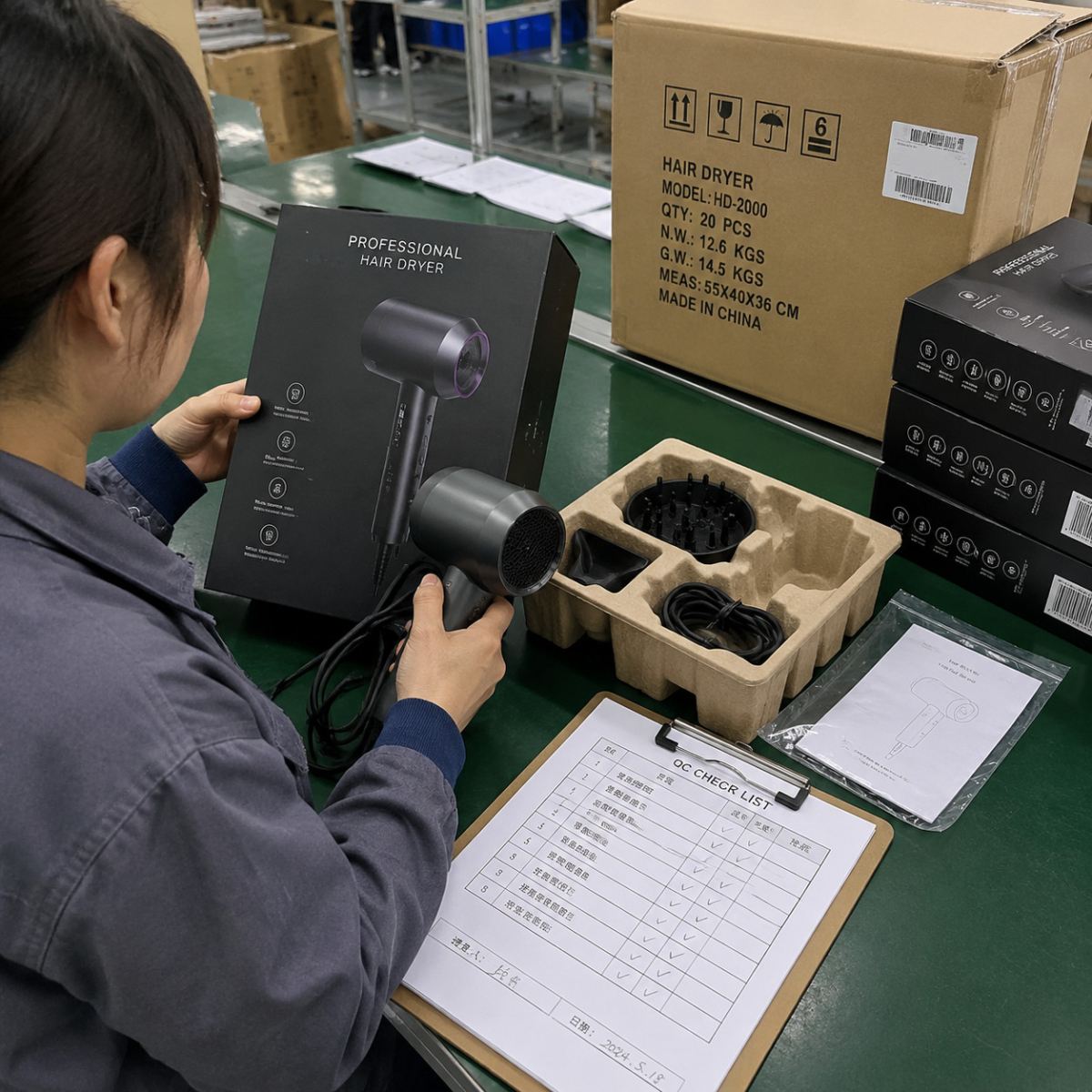
What Hair Dryer Quality Control Covers
Hair dryer quality control is a documented manufacturing process that connects component approval, production controls, electrical safety, airflow and temperature performance, reliability, packaging accuracy, outgoing inspection, and traceability. BAILE applies control points before, during, and after assembly so quality is built into the order instead of depending only on a final random check. Every project is linked to its confirmed model, voltage, power, plug, functions, appearance, packaging, and market requirements.
Quality Begins Before Assembly
BAILE starts with the released product specification, bill of materials, component criteria, visual references, function matrix, packaging files, and market configuration. No incoming lot moves to routine production until it matches the order record. Motor inspection confirms identity and operating condition. For the heater set, inspectors verify its construction, mounting position, electrical clearances, thermostat location, and thermal-fuse location. PCB review addresses part condition, solder joints, connections, key response, control logic, and applicable temperature feedback. Power cords and plugs are matched to voltage, destination format, length, conductor specification, and termination quality.
Molded parts, nozzles, filters, switches, printed matter, retail packs, protective trays, and shipping cartons also remain tied to approved references. Release checks cover color, dimensions, finish, mating condition, print accuracy, barcode data, language, certification marks, and pack details. Inspection depth follows risk: safety- or function-critical items may be examined unit by unit, while lower-risk parts and packaging use the sampling frequency assigned to the lot. Rejected material is tagged, segregated, logged, reviewed, and blocked from routine assembly until an authorized disposition and follow-up check are complete.
Quality Continues Through Shipment
After materials are released, BAILE approves the first completed unit to verify the line setup against the signed reference. Inspectors compare the pilot unit with the visual master, operating-mode matrix, measured airflow and heat targets, acoustic reference, attachment fit, electrical configuration, labeling, retail pack, and master-carton instructions. Reconfirmation is required when a new order or any change in color, pack version, component, repaired mold, or process could alter the approved result.
IPQC personnel check injection molding, surface finishing, printing, motor installation, heating assembly installation, wire routing, housing closure, button feel, nozzle fit, labeling, and packing during production. Finished units then pass applicable function, performance, electrical safety, aging, reliability, packaging, and outgoing checks. The final release can include full inspection, sampling, customer-defined standards, AQL inspection, and third-party verification. Production dates, material batches, line information, quality records, packaging records, and shipment information support later traceability. This structure connects daily manufacturing control with complaint analysis, corrective action, and improvement on repeat orders.
Quality Risks Controlled Before Shipment
BAILE builds hair dryer projects around the quality risks that affect retail acceptance, user experience, returns, compliance, and repeat purchasing. Control begins with confirmed specifications and approved components, continues through first article and process inspection, and ends with documented testing, packaging checks, outgoing inspection, and traceability. The following risks are addressed through specific manufacturing actions rather than general quality claims.
Sample Production Gap
BAILE links mass production to the approved specification, bill of materials, signed sample, color reference, function settings, packaging files, and first article record. Production changes that can affect appearance, airflow, temperature, noise, assembly, or packaging trigger renewed confirmation. This prevents an attractive development sample from becoming an uncontrolled production reference.
Motor Batch Variation
Motor control includes model identification, operating condition, current, speed, vibration, abnormal sound, impeller matching, fixation, and assembled-unit performance. BAILE connects incoming motor checks with airflow, noise, aging, and finished-product inspection so a motor batch is reviewed by both component condition and its effect on the complete dryer.
Temperature Instability
BAILE checks heating assemblies, thermostats, thermal fuses, NTC-related control where applicable, airflow conditions, outlet temperature, and temperature rise at critical areas. Low, medium, high, constant-temperature, and cold-air functions are verified according to the model. Abnormal heating or protection behavior is recorded and separated before release.
Electrical Safety Failure
Electrical safety controls can include hi-pot, insulation, leakage current, grounding where applicable, temperature rise, cord pull, cord flex, and overheat protection checks. BAILE connects these tests with material selection, internal wire routing, heating structure, PCB assembly, housing construction, rated voltage, power, plug, and market-specific project requirements.
Noise and Vibration
Noise performance is affected by the motor, impeller balance, air duct resistance, housing resonance, assembly accuracy, and operating mode. BAILE records noise under defined distance and test conditions, checks abnormal sound and vibration during operation, and links the result with motor installation, impeller condition, fastening, airflow, and housing fit.
Packaging Version Errors
Packaging control confirms every approved retail and shipping element, from the primary box and protective tray to inserts, product identifiers, accessories, pack count, language, and master-carton markings. Artwork and packing instructions are released before the line starts. At outgoing inspection, BAILE verifies that the finished model and plug are paired with the correct document set, labels, accessory kit, and carton arrangement.
Certification Mismatch
Certification support is mapped to the exact configuration being sold: model construction, electrical rating, mains connection, safety-relevant parts, destination, product marking, and instructions. BAILE does not extend a document beyond its stated scope. Existing evidence and any required new test route are therefore checked against the commercial version before production files and shipment documents are finalized.
Missing Batch Traceability
Each order can carry a traceable record trail from component receipt and line scheduling through inspections, packing, carton identification, and dispatch. If a field issue appears, BAILE reconstructs the relevant manufacturing history and reviews the reported symptom, available images or video, affected scope, and retained quality evidence. The investigation and corrective action are based on records rather than recollection.
BAILE Quality Control System
BAILE uses an eight-stage quality control structure for OEM and ODM hair dryer production. Each stage has a defined purpose, controlled inputs, inspection actions, records, and release decisions. The system covers the materials that enter the factory, the standards used on the line, the tests applied to the assembled product, the information checked before shipment, and the records used after delivery. Records connect each decision with the applicable product, batch, inspector, and release status.
Supplier and Material Control
BAILE controls suppliers and specifications for motors, heating assemblies, PCB boards, thermostats, thermal fuses, ionic components, cords, plugs, plastic materials, nozzles, labels, manuals, and packaging. Material identity, batch information, approved samples, test documents, delivery stability, and previous quality performance support the release decision for repeat and new orders. The release status is documented before components enter normal production.
Incoming Quality Control
IQC verifies incoming identity, quantity, lot information, appearance, dimensions, color, labeling, function, and any applicable safety characteristic. The control plan assigns inspection intensity by component risk and supplier history; this can mean complete screening for designated critical items or a documented sample for routine parts and packaging. Failed lots are marked, quarantined, entered in the nonconformance record, and checked again after disposition. Material reaches assembly only after release by the responsible function.
First Article Approval
Before normal line output continues, BAILE compares the first assembled unit with the locked specification and signed sample. The review combines cosmetic limits, branding and finish, mode response, measured drying performance, sound, attachment engagement, destination-specific electrical parts, documentation, accessory set, and pack-out details. Once signed, this unit becomes the shop-floor reference. A discrepancy pauses release until correction and a fresh verification are recorded.
In-Process Quality Control
IPQC covers injection molding, finishing, printing, component placement, motor fixation, heater positioning, wire routing, housing closure, screw torque, controls, nozzles, labels, accessories, and packing. The order plan sets patrol intervals by elapsed time, produced lot, process stage, or identified risk; customer-specific checkpoints can be added. Inspectors stop and segregate abnormal output, then log the finding with its line, operation, batch, and inspection time.
Functional Performance Testing
BAILE verifies startup, speed and heat selection, cool-shot response, display behavior, ionic output where fitted, mode transitions, air delivery, outlet heat, acoustics, vibration, attachment engagement, and model-specific features. Recorded test conditions link each result to the released specification, replacing subjective judgment with agreed limits. A failed reading places the affected output on hold; the team investigates, corrects the cause, and records the verification before release resumes.
Safety Reliability Verification
Verification is divided by purpose. Electrical protection checks address dielectric strength, insulation condition, leakage, and protective-earth continuity when the design uses grounding. Thermal work examines temperature rise and protective cut-off behavior. Endurance work may add running observation, cord and switch cycling, impact, vibration, or environmental exposure. BAILE selects the final combination from the construction, rating, use scenario, destination rules, and agreed quality standard, then records the model, method, condition, and limit with each result.
Final Outgoing Inspection
FQC and OQC check finished appearance, function, airflow, temperature, noise, cord, plug, nozzle, accessories, packaging, labels, quantity, carton information, and shipment documents. Release can use full inspection, sampling, customer-defined criteria, and AQL levels such as 1.0, 1.5, 2.5, or 4.0 according to the agreed order plan.
Traceability and Improvement
Batch information connects the order number, production date, materials, production line, inspection records, packaging records, and shipment information. Customer feedback is reviewed against these records. BAILE then applies supplier correction, process adjustment, employee training, inspection updates, packaging improvement, rework, replacement, or preventive action according to the confirmed cause and affected scope.
Factory Resources Behind Quality Control
BAILE connects quality control with manufacturing resources rather than separating inspection from production. The supporting manufacturing system includes engineering, tooling, injection molding, assembly, inspection, aging, packaging, warehousing, and project coordination. The reference data below defines the current page scope and must remain consistent with the company profile, factory pages, audit documents, sales materials, and future content updates. These resources support repeatable inspection, controlled production flow, and documented shipment decisions for B2B orders.
| Resource | BAILE Reference Data | Quality Control Role |
|---|---|---|
| Manufacturing area | 10,000 m² manufacturing-system footprint | Supports assembly, inspection, aging, packaging, storage, and controlled material flow |
| Total team | Approximately 800 people | Covers engineering, production, quality, project coordination, warehouse, packaging, logistics, and support |
| R&D and engineering | 30+ people | Controls structure, airflow, heating, electrical design, samples, tooling, and production change review |
| Quality control team | 10+ people | Supports incoming, process, finished-product, outgoing, record, and abnormal-product control |
| Assembly lines | 10 lines | Provides defined production stations, first article control, patrol inspection, and line-specific records |
| Injection machines | 100 automatic machines | Supports molded-part control for housings, handles, nozzles, filters, buttons, and related plastic components |
| Aging rooms | 12 independent rooms | Each room can hold approximately 50-100 units for continuous operating and functional observation |
| Reference monthly capacity | Approximately 40,000 units | Provides a planning reference for controlled OEM and ODM production across different product types |
| Test equipment | Airspeed, temperature, noise, electrical, cord flex, drop, and related equipment | Supports performance, electrical safety, reliability, packaging, and project-specific verification |
| Third-party inspection | SGS, BV, Intertek, or customer-appointed inspection support | Provides independent pre-shipment verification when included in the order plan |
Incoming Quality Control for Components
BAILE uses incoming quality control to prevent incorrect, unstable, damaged, or unapproved materials from entering normal production. IQC is linked with the approved model, BOM, technical specification, reference sample, color requirement, market voltage, plug format, packaging version, and applicable test documents. Inspection depth changes by material risk: critical electrical and functional components receive stronger control, while ordinary materials and packaging follow defined sampling or batch checks. Release status remains linked with the applicable material batch and confirmed order.
Specifications Locked Before Material Release
BAILE converts the confirmed product into controlled material requirements before normal production begins. The controlled information can include motor type, rated voltage, power route, heating assembly, thermostat, thermal fuse, PCB version, ionic component, switch, cord, plug, housing material, color reference, nozzle structure, printed logo, labels, manual, inner tray, color box, and outer carton. Incoming material is checked against this information rather than accepted only by supplier name or visual similarity.
Supplier control covers qualification information, material specifications, incoming batch identity, available test documentation, approved samples, delivery performance, abnormal feedback, and repeated batch stability. New parts, changed parts, alternative materials, repaired tools, revised packaging, or new suppliers require renewed confirmation before unrestricted use. BAILE does not treat a verbal promise from a component supplier as production approval. The receiving, engineering, quality, project, and production functions use the current controlled reference to decide whether material is accepted, held, returned, sorted, reworked, or submitted for further verification.
The tightest controls apply to parts that influence energy conversion, temperature regulation, mains connection, and flame or heat resistance. These include the drive system, heater set, electronic controller, protective devices, cable assembly, market plug, and plastics located near hot zones. Two parts may look alike yet produce different current draw, air delivery, thermal behavior, fit, noise, document coverage, or durability. Release decisions therefore consider functional impact, not appearance alone.
Critical Component Inspection Points
BAILE checks the specified motor, external condition, running behavior, speed, current, vibration, unusual sound, impeller pairing, and mounting requirements. Heater inspection examines winding integrity, support geometry, placement in the air path, electrical clearance, protective-device positioning, and visible damage. PCB assemblies are reviewed for component identity, solder quality, wiring, connectors, key response, control logic, temperature feedback, display, ionic control, and any additional function built into the selected model.
Cord and plug inspection covers market format, rated voltage, wire specification, length, conductor condition, terminal connection, strain relief, appearance, and applicable continuity or mechanical checks. Molded parts are checked for color difference, shrinkage, flash, deformation, scratches, weld lines, clip condition, screw posts, openings, dimensions, and assembly fit. Nozzles, filters, buttons, decorative parts, and internal supports are checked against their approved fit and appearance references.
Packaging inspection begins before mass packing. BAILE checks printed content, logo position, barcode, language, safety information, certification marks, carton strength, label data, accessory list, packing quantity, and version number. This prevents the correct product from being combined with an incorrect plug description, old manual, wrong barcode, missing accessory, or obsolete packaging file.
Nonconforming Material Control
Incoming material that fails the required check is identified and separated from accepted stock. BAILE records the material, supplier, batch, quantity, defect description, inspection result, and initial affected scope. The disposition can include supplier return, sorting, rework, replacement, engineering review, additional testing, conditional approval through an authorized process, or rejection. Material is not returned to normal use only because a delivery schedule is tight.
The quality team connects incoming defects with possible production and market effects. Motor abnormal sound can affect finished noise and returns. Incorrect heating components can affect outlet temperature, temperature rise, protection behavior, and certification. Color variation can affect brand presentation and retail acceptance. Incorrect cords, plugs, manuals, or labels can create market compliance and shipment errors. This risk-based review determines the required containment and reinspection.
Supplier feedback and corrective action are recorded for repeated or important defects. BAILE can update inspection focus, sampling depth, approved references, incoming limits, supplier requirements, or production controls according to the issue. This prevents incoming inspection from becoming a one-time receiving activity and makes it part of continuing batch-quality management.
First Article and Process Inspection
BAILE uses first article approval and in-process inspection to keep the approved product connected with daily production output. A signed sample alone cannot control every line action. The factory also needs a current specification, BOM, appearance limits, functional settings, packaging files, first article record, patrol points, abnormal-product rules, and change-control process. These controls reduce variation between development samples, pilot production, repeated orders, and mass shipment. Recorded findings support immediate containment, correction, reinspection, and controlled production continuation.
First Article Approval Before Production
First article approval is required before a new production run is allowed to continue. BAILE checks the first completed product against the approved specification, signed sample, color reference, surface finish, logo position, assembly condition, power and voltage configuration, operating modes, airflow, outlet temperature, noise, vibration, nozzle fit, cord, plug, manual, labels, accessories, packaging, and outer-carton information. Production, quality, engineering, and project personnel participate according to the order and change level.
Renewed confirmation is used when a new order begins, a new color enters production, packaging changes, an accessory changes, a material or component changes, a mold is repaired, a process is adjusted, or another change can affect the product. The output can include a first article record, limit sample, signed sample, packaging reference, and line standard. This makes the accepted condition visible to operators and inspectors instead of leaving the requirement inside an email thread.
The first article is also checked as a complete commercial product. BAILE confirms not only whether the dryer switches on, but also whether the correct market plug, product label, manual language, barcode, accessories, color box, carton mark, and packing quantity are present. Production release follows the full approved configuration.
IPQC During Critical Operations
BAILE applies process inspection to molding, coating, printing, laser marking, component assembly, wire routing, fastening, enclosure closure, drive and heater installation, PCB connection, key operation, nozzle assembly, labeling, accessory placement, and packing. Frequency is assigned by time, lot, process risk, and customer requirement. A typical order may call for a three-hour patrol interval, a check after two produced lots, a checkpoint at each critical operation, or a dedicated schedule written for that project.
IPQC checks visible consistency, structural fit, fastening, wire protection, component position, operating feel, label position, packing direction, and other points that cannot be corrected efficiently after the order is fully completed. Motor position affects vibration and noise. Heating assembly position affects air path, temperature, and internal safety distance. Wire routing affects insulation, pinching, heat exposure, and assembly closure. Screw torque and housing fit affect gaps, abnormal sound, strength, and appearance.
When abnormal output is found, BAILE can stop the affected operation, identify and isolate suspect units, confirm the time and batch range, review the setup, correct the cause, and reinspect the affected production. Normal output resumes after the control condition is restored. This prevents a local line issue from becoming an entire shipment issue.
Controlled Changes and Reapproval
BAILE treats production change as a quality event when the change can affect function, safety, appearance, assembly, packaging, certification, or customer acceptance. Changes can involve a motor, PCB, heating component, thermostat, thermal fuse, plastic material, color, surface treatment, mold condition, cord, plug, nozzle, label, manual, packaging material, assembly method, inspection method, or production location. The affected information is reviewed before the revised condition enters normal production.
Engineering and quality personnel check whether the change requires a new sample, dimensional check, function test, airflow test, temperature test, electrical safety test, aging observation, packaging check, certification review, or customer confirmation. The new condition is connected with a version, record, and updated production reference. Obsolete materials, old packaging files, and superseded instructions are separated from the current order where required.
This change-control structure supports repeat purchasing because later orders can return to a known, approved configuration. It also supports complaint investigation: the production record can show whether an issue occurred before or after a material, process, or document change. BAILE uses the result to strengthen preventive controls on subsequent orders.
Critical Component Quality Control
Hair dryer quality depends on how the motor, impeller, heating system, control board, protection components, cord, plug, housing, and air path work together. BAILE checks component identity and condition before assembly, verifies installation during production, and confirms the effect on the finished dryer through function, performance, safety, aging, and outgoing inspection. The control points below connect component quality with measurable product results. Component records connect incoming acceptance with assembled performance and finished-product release.
Motor and Impeller
BAILE checks motor model, voltage route, external condition, operation, speed, current, vibration, abnormal sound, impeller matching, dynamic behavior, fixation, and assembled performance. Motor control is linked with airspeed, airflow, noise, aging, and outlet-temperature stability. High-speed brushless, brushed retail, and salon-oriented motor routes use different inspection and validation priorities. BAILE records incoming and assembled-unit findings against the relevant motor batch before release.
Heating Assembly
Heating assembly checks cover wire condition, carrier structure, winding uniformity, mounting, required clearances, alignment with the air path, connections, damage, and running stability. BAILE then evaluates the heater together with motor output and airflow because electrical input, warm-up response, delivered heat, internal temperature rise, and protective action interact. A nonconforming result leads to quarantine of the related parts or units, root-cause work, corrective action, and a recorded confirmation test.
PCB and Controls
BAILE checks electronic components, solder joints, connectors, wiring, program version, button response, display, speed and heat control, ionic function, cold-air function, NTC feedback, memory or mode functions where included, and protection logic. PCB inspection continues through assembled-unit testing because stable board output must also produce the correct motor, temperature, display, and safety response. Version and test records remain linked with the approved production configuration.
Thermal Protection Parts
Thermostats, thermal fuses, NTC sensors, insulation parts, and related protection components are checked for correct specification, installation position, connection, and function according to the product design. BAILE connects protection checks with airflow, heating assembly position, blocked-air or abnormal-temperature conditions where included, and temperature-rise results at the housing, handle, outlet, PCB area, and cord connection. Any mismatch is contained before affected assemblies proceed to final testing.
Cord and Plug
Cord and plug control covers market format, rated voltage, wire specification, length, terminal connection, conductor condition, strain relief, continuity, appearance, pull resistance, and flex performance according to the project. Salon and hotel products can use stronger durability controls for frequent movement, while travel and regional products require exact voltage, plug, label, and manual alignment. BAILE records the verified configuration with the applicable product and market version.
Housing and Air Path
BAILE checks plastic material, color, surface condition, dimensions, clips, screw posts, assembly gaps, inlet, filter, impeller clearance, duct joints, outlet, nozzle fit, and high-temperature areas. Housing and air-path control affects appearance, strength, leakage, vibration, airflow efficiency, noise, heat distribution, anti-hair-ingress design, handling, and repeatable assembly across production batches. Inspection records connect molded-part batches with assembly findings, finished performance, and release status.
Functional and Performance Testing
BAILE verifies finished hair dryers against their confirmed operating specification and project positioning. Testing covers basic operation and the measurable performance created by the motor, impeller, air duct, heating assembly, control board, housing, nozzle, and software logic. Test conditions are recorded by model and order so results from samples, pilot production, mass production, and outgoing inspection can be compared on a consistent basis. Results are compared with defined methods and the approved project configuration.
Function Verification
BAILE checks power-on operation, speed settings, heat settings, cold-air function, mode switching, buttons, indicators, display, ionic function, memory functions where included, nozzle attachment, and model-specific features. Finished units are checked against the approved function sequence so incorrect wiring, wrong programs, reversed settings, missing functions, and unstable controls are found before shipment.
Power Measurement
Power is measured under the rated voltage and defined operating modes. BAILE compares the result with the approved specification, product label, manual, heating route, motor route, and market configuration. Power is reviewed together with airflow, outlet temperature, temperature rise, cord specification, plug, safety protection, and certification requirements rather than treated as an isolated marketing number.
Voltage and Current
BAILE verifies operation under the required 100-120V, 220-240V, dual-voltage, or project-specific route. Current behavior is checked across relevant settings and operating conditions. The test confirms that the motor, heating system, PCB, cord, plug, label, and manual match the selected electrical configuration and that each operating mode remains stable under the specified supply condition.
Airspeed Testing
Airspeed is measured at a defined outlet position, operating mode, nozzle condition, and distance. BAILE records how motor type, speed, impeller design, inlet restriction, duct geometry, outlet size, and nozzle affect the result. Batch checks compare production output with the approved reference to control fast-drying performance, styling concentration, and user-experience consistency.
Airflow Testing
Airflow measures the volume of air delivered over time and complements airspeed data. BAILE uses airflow checks to review motor and impeller matching, inlet area, filter resistance, duct cross-section, leakage, outlet geometry, and nozzle influence. This helps distinguish efficient air delivery from a product that only creates a narrow or noisy high-speed sensation.
Outlet Temperature
BAILE checks low, medium, high, constant-temperature, and cold-air settings according to the product. The record can include warm-up behavior, temperature stability, setting difference, response to control input, and protection action. Results are connected with airflow, heating power, sensor position, thermostat, thermal fuse, housing structure, and intended use such as kids, pets, salon, or home care.
Noise and Vibration
Noise is measured under a defined environment, distance, product position, nozzle condition, and operating mode. BAILE also checks abnormal sound, vibration, housing resonance, motor fixation, impeller behavior, and assembly condition. Recording the test method prevents an unsupported decibel value from being compared with results collected at a different distance or under different background noise.
Ionic Function Test
For models with ionic function, BAILE checks whether the function is present, connected, activated, and stable according to the approved configuration and available test method. Inspection focuses on component identity, wiring, control response, and repeatable operation. Product claims, packaging language, and manuals remain aligned with the confirmed feature and applicable market requirements.
Electrical Safety Test Controls
BAILE connects electrical safety testing with product design, material selection, component specifications, internal spacing, wire routing, heating structure, PCB control, rated voltage, power, plug, and target market. Applicable tests are defined by the product construction and project requirements. Test records support production control and certification work, but no single test is presented as a substitute for the complete safety design and compliance process. Test records identify the applicable model, condition, result, and release decision.
Hi-Pot Test
BAILE uses hi-pot testing to verify whether the electrical insulation system withstands the defined test condition without breakdown. The control is connected with internal wiring, heating components, PCB areas, motor connections, insulation materials, housing construction, assembly quality, and required safety distances. Test settings and acceptance criteria follow the applicable product and project standard. Failed units are isolated, reviewed, corrected, and retested before release.
Insulation Verification
Insulation checks focus on separation between live parts and accessible or surrounding structures. BAILE reviews wire condition, insulation sleeves, heating assembly support, PCB clearance, motor connection, routing near hot areas, pinched-wire risk, and housing closure. Inspection and testing work together because an acceptable component can become unsafe if it is incorrectly routed or assembled. Any routing or clearance deviation is contained and rechecked before production continues.
Leakage Current
Leakage current is checked under the defined operating and electrical condition for the selected product. BAILE records the result against the applicable project requirement and investigates abnormal readings before release. The test is considered together with insulation, heating condition, PCB design, grounding where applicable, moisture-related risk, component condition, and rated voltage. Abnormal units remain isolated until cause, correction, and reinspection are documented.
Ground Continuity
For products using a grounding structure, BAILE checks whether the grounding path is correctly assembled and electrically continuous. The control covers connection points, terminals, conductors, fastening, and resistance according to the applicable requirement. Products with double-insulated or different constructions follow the safety route defined for that design rather than receiving an irrelevant grounding claim. The applicable construction and result are recorded in the project test file.
Temperature Rise
BAILE measures temperature rise at relevant locations such as the housing, handle, outlet, heating area, PCB area, cord connection, and accessible contact points. The result is reviewed with motor airflow, heating power, material resistance, internal spacing, duct condition, operating mode, and test duration. Abnormal temperature leads to containment and design or process review. Corrected units must pass repeated checks before returning to normal release.
Overheat Protection
Protection verification checks the behavior of the thermostat, thermal fuse, NTC control, control-board logic, motor condition, and airflow system under the applicable test scenario. BAILE confirms that the installed protection route matches the approved product design. Blocked-air, abnormal-temperature, or shutdown checks are included when required by the project and applicable standard. Results are recorded with the tested mode, condition, unit, and disposition.
Reliability and Durability Verification
BAILE uses aging and reliability verification to expose early failures, weak connections, unstable temperature behavior, abnormal motor operation, component wear, structural weakness, and packaging risk before shipment. The test plan is built around the product type, expected use frequency, target market, construction, order value, and customer standard. Reference conditions below describe available control routes; final settings are confirmed for the exact model and project. Final parameters are confirmed in the project test plan before production release.
| Test | BAILE Reference Route | Main Control Purpose | Typical Application |
|---|---|---|---|
| Finished-unit aging | Continuous operation for a common reference of 2-4 hours, or extended by project | Finds early motor, heating, function, odor, temperature, shutdown, and ionic-operation abnormalities | High-speed, salon, wall-mounted, pet, high-power, and other models |
| Motor life observation | Duration set by motor type and product grade | Reviews operating stability, abnormal sound, vibration, heat, speed decay, and stoppage | High-speed, salon, premium, and frequent-use dryers |
| Heating continuity | Repeated or continuous operation under defined settings | Reviews heating stability, connection, insulation, temperature control, and protection response | All heated-air products |
| Cord flex test | Common reference of 10,000-20,000 cycles, or project-defined | Controls conductor breakage, intermittent power, strain-relief weakness, and connection failure | Salon, hotel, household, and frequent-movement products |
| Button life test | Common reference of 10,000-30,000 operations, or project-defined | Controls switch, slider, key, contact, and control-response failure | All product categories |
| Drop test | Product or packed-product method defined by project | Reviews housing strength, internal movement, accessory protection, and post-drop function | Retail, e-commerce, travel, and gift projects |
| Packaging vibration | Transport simulation according to project | Reviews inner-tray fixation, carton strength, abrasion, movement, accessory damage, and shipping protection | Export, retail, e-commerce, and long-distance shipments |
| High-low temperature | Arranged for projects requiring environmental verification | Reviews plastic, coating, electronics, packaging, fit, and functional stability under storage or transport conditions | Large customer, premium, and cross-region projects |
| Nozzle fit test | Repeated attachment, pull, rotation, or magnetic-retention check | Controls loose fit, unstable magnets, weak clips, difficult removal, and inconsistent user feel | Concentrator, diffuser, styling, and magnetic-nozzle models |
Quality Priorities by Hair Dryer Type
BAILE adjusts quality control according to the construction, user scenario, duty cycle, temperature strategy, accessories, installation method, and market position of each hair dryer. A high-speed brushless model, salon dryer, wall-mounted hotel unit, kids dryer, and pet dryer do not carry the same performance and use risks. The matrix below shows how BAILE translates product type into focused inspection and verification points. Each route uses controls aligned with its construction, use environment, and sales channel.
| Hair Dryer Type | Primary Quality Controls | Key Production Risks Controlled |
|---|---|---|
| High-speed hair dryer | Brushless motor, PCB, airspeed, temperature response, noise, vibration, magnetic nozzle, aging | Motor variation, program error, unstable speed, resonance, heat fluctuation, loose accessories |
| Standard household dryer | Basic function, power, temperature protection, housing, cord, packaging, batch consistency | Setting errors, assembly variation, cosmetic defects, packaging mistakes, cost-driven component changes |
| Professional salon dryer | Continuous operation, airflow, handle temperature rise, cord flex, motor life, nozzle retention | Frequent-use wear, excessive heat, cord failure, motor decay, loose nozzle, operator fatigue |
| Travel hair dryer | Folding-handle life, dual-voltage route, plug, compact structure, packing | Hinge weakness, voltage-selection error, plug mismatch, heat concentration, transport damage |
| Wall-mounted hotel dryer | Bracket strength, holder switch, safety shutdown, cord, anti-theft structure, installation kit | Loose mounting, switch failure, missing hardware, frequent guest misuse, mixed accessories |
| Pet dryer | Adjustable airflow, soft temperature, noise, hose or nozzle connection, continuous operation | Animal discomfort, excessive temperature, hose leakage, unstable controls, abnormal sound |
| Kids hair dryer | Low-temperature strategy, anti-scald housing, low noise, anti-hair-ingress design, light weight | Excessive outlet temperature, hot housing, hair ingress, fear-inducing noise, heavy handling |
| Straightening dryer | Brush-tooth strength, hot-air distribution, anti-scald construction, attachment fit | Loose teeth, uneven heat, hot contact areas, unstable accessories, difficult cleaning |
| Multi-styler | Attachment recognition or fit, heat and speed control, repeated changeover, packaging completeness | Missing attachments, loose connection, incorrect mode, uneven output, set-packing errors |
Final Inspection and Third-Party Verification
BAILE uses finished-product inspection, packaging checks, outgoing inspection, AQL sampling, and optional third-party verification to control shipment release. Final inspection does not replace earlier process control; it confirms that the completed order still matches the approved product, packaging, quantity, labels, accessories, documents, and customer inspection plan. Failed findings are contained and corrected before the affected goods are released. Release occurs only after findings, corrections, and reinspection status are documented.
FQC and Packaging Inspection
Finished quality control checks the completed dryer for appearance, assembly, power-on operation, speed and heat settings, cold-air function, display or indicator, ionic function where included, airflow, outlet temperature, noise, vibration, buttons, cord, plug, nozzles, accessories, labels, and visible damage. Inspection can be full, sampled, or arranged according to a customer-defined plan. Results are recorded with nonconforming, rework, reinspection, and release information.
Packaging inspection follows the released pack-out specification. It verifies the selected retail pack, internal protection, instruction and after-sales inserts, required warnings, product and logistics identifiers, destination marks, e-commerce labels where applicable, accessory set, unit count, and master-carton data. BAILE also checks artwork accuracy, language, logo placement, barcode readability, compliance information, weights, dimensions, and transport protection. Distribution risk can add drop, vibration, stacking, compression, or carton-strength verification.
Completed packaging records stay linked with the finished-product lot, inspection result, and final shipment release decision.
OQC and AQL Release
Outgoing quality control is performed before final shipment release. BAILE confirms the order number, model, color, logo, plug, voltage information, packaging version, carton mark, packed quantity, shipping quantity, weight data, and required documents. The outgoing record can include the inspection result, packing list, commercial invoice, carton labels, test documents, certification documents, inspection documents, and shipment photographs according to the order.
AQL inspection can be arranged for appearance, function, safety-related checks, packaging, labels, quantity, and accessory completeness. Available reference levels include AQL 1.0, 1.5, 2.5, and 4.0, with the final critical, major, minor, sample-size, and acceptance criteria defined in the agreed inspection plan. BAILE does not present one AQL number as suitable for every order. The selected level reflects product risk, customer standard, channel requirement, order value, and previous quality performance.
Sample selection, findings, rework, and renewed inspection are documented before the shipment release decision is signed.
Customer and Third-Party Inspection
The finished lot can be opened for customer inspection or verification by an appointed body, including SGS, Bureau Veritas, or Intertek. The agreed scope may examine cosmetics, operation, pack-out, labeling, dimensions, weight, quantity, accessories, record consistency, and selected on-site tests. BAILE stages the released goods and provides a suitable inspection area together with the controlled specification, pack references, shipment list, relevant quality evidence, and available certification or laboratory files.
Third-party inspection remains an independent activity. BAILE coordinates access, samples, records, corrective work, and reinspection without claiming to represent or replace the inspection organization. When a finding is raised, affected goods are identified and isolated, the cause and scope are reviewed, correction or rework is completed, and the lot is rechecked before shipment approval. This provides a transparent release route for high-value, retail, import, hotel, e-commerce, and large brand programs.
The inspection outcome and any closure evidence remain linked with the affected order, carton scope, and final release record for later customer review.
Certification Support by Target Market
BAILE supports market-specific certification, laboratory testing, marking, and technical-document routes for global hair dryer programs. The compliance matrix links the commercial product to its construction, electrical rating, connection system, safety-critical parts, destination, packaging statements, product label, and instructions. Existing certificates and reports are screened for exact model relevance. Where the configuration falls outside that evidence, BAILE coordinates the applicable new test, update, or transfer route rather than presenting unrelated paperwork as universal coverage.
| Target Market | Certification and Compliance Route | BAILE Project Control |
|---|---|---|
| European Union | CE, LVD, EMC, RoHS, REACH, ErP, and applicable product testing | Confirms 220-240V route, EU plug, materials, label, warnings, manual language, packaging, and model-specific documents |
| United Kingdom | UKCA and UK-market documentation where applicable | Confirms UK plug, voltage, label, warning, manual, packaging, and applicable transition requirements |
| North America | ETL, UL, cETL, cUL, FCC where relevant, and project-specific safety evaluation | Confirms 100-120V route, cord and plug, power, construction, critical components, label, manual, and model coverage |
| Japan | PSE route and Japan-market documentation | Confirms 100V configuration, plug, cord, label, Japanese manual, packaging, and product-specific requirements |
| South Korea | KC route and Korean-market documentation | Confirms voltage, plug, label, Korean manual, packaging, and applicable model documents |
| Australia and New Zealand | SAA or RCM-related route according to project | Confirms AU plug, voltage, cord, label, manual, packaging, and applicable electrical documents |
| International or multi-market | CB and IEC-related testing support | Connects the base construction, voltage versions, critical components, reports, and destination-market conversion plan |
| German or selected European retail | Optional GS route where required | Confirms exact model, retail-channel requirement, test scope, labeling, and certification cost and schedule |
Batch Traceability and Corrective Action
BAILE connects quality control with batch records so a reported problem can be traced to the relevant order, production period, material condition, line activity, inspection result, packaging version, and shipment. The objective is not to claim that no product can ever fail. The objective is to identify the affected scope, control further risk, determine the cause, complete corrective work, and strengthen preventive controls for later production. The same records support complaint review, containment, correction, and repeat-order improvement.
Production and Shipment Traceability
BAILE can assign a traceability chain that starts with the sales order and component lots, follows the scheduled line and production date, and continues through first-off approval, patrol findings, test results, packing activity, outgoing release, carton coding, and dispatch. Record depth is set in the order control plan. The resulting links allow a physical shipment or reported unit to be matched with the manufacturing evidence behind its release.
When a customer reports a problem, BAILE collects the product model, quantity, batch information, images, video, failure description, use environment, operating condition, packaging condition, and date of occurrence. The quality team compares this information with available production and inspection history. The review can identify whether the issue is isolated, related to a material lot, linked with a production period, caused by packing or transport, associated with use conditions, or present across a wider quantity.
Traceability also supports proactive containment. If an abnormal motor, PCB, heating part, packaging version, or process condition is found internally, BAILE can review where the affected material was used and separate related work in progress, finished goods, or shipment stock. This reduces the risk of treating every product as affected or overlooking units that share the same cause.
Nonconforming Product Control
Nonconforming material, work in process, finished goods, packaging, or shipment output is identified, isolated, recorded, and reviewed. BAILE determines the affected quantity and prevents uncontrolled mixing with accepted goods. Disposition can include sorting, rework, component replacement, repacking, additional testing, return to supplier, scrap, authorized review, or rejection. Corrected goods are reinspected before release.
The review separates defect symptoms from causes. A dryer that stops can involve a motor, PCB, thermal protection part, connection, cord, plug, switch, assembly condition, or abnormal use environment. High outlet temperature can involve airflow restriction, motor output, heating power, sensor location, thermostat, thermal fuse, duct condition, or assembly position. Packaging damage can involve the inner tray, carton strength, accessory movement, product fixation, stacking, vibration, or external transport handling.
BAILE uses the confirmed cause and risk level to decide the required correction. This prevents a cosmetic rework from being used for an electrical problem or a component replacement from being used without checking the affected production process.
CAPA and Repeat-Order Improvement
Corrective and preventive action can include supplier correction, incoming-inspection adjustment, material replacement, tooling correction, fixture improvement, work-instruction revision, process setting change, operator training, inspection-frequency increase, added test points, packaging redesign, approved-reference update, or engineering change. BAILE records the action, responsible function, completion condition, and verification result according to the importance of the issue.
Customer response can include the analysis result, affected scope, corrective action, rework plan, replacement parts, product replacement, agreed compensation route, and preventive action for later orders. Warranty handling is confirmed by product type, target market, order quantity, and project terms. The current company reference is generally one year after shipment, with cash or product-based settlement routes available according to the confirmed case and agreement.
Repeat orders use the complaint and CAPA result to strengthen prevention. Updated materials, samples, inspection limits, packaging files, and work instructions are connected with the next production release. BAILE uses this closed-loop approach to reduce repeated defects, improve batch consistency, and support stable long-term supply.
Quality Evidence Available for Review
BAILE supports quality review with physical equipment, controlled references, inspection records, test data, certification documents, and shipment records. Evidence is more useful when it identifies the product, test, date, condition, result, and responsible record. The following document and image categories can be prepared according to project relevance, confidentiality, certificate ownership, customer authorization, and the exact product model. BAILE identifies each item clearly so evidence supports a specific quality decision.
Laboratory Test Equipment
Available equipment includes airspeed, airflow, temperature, noise, voltage and current, hi-pot, grounding resistance, leakage current, cord flex, button life, drop, packaging vibration, and related verification devices. Equipment images are paired with the test purpose and applicable product instead of being used as an unexplained laboratory background. Model, range, calibration status, and test method can be reviewed where relevant. Relevant status evidence can be included in the project review package.
Calibration and Equipment Records
BAILE connects measurement equipment with identification, maintenance, calibration, verification, or status records according to the device and management requirement. This supports confidence that two production batches are not compared with an uncontrolled instrument. Quality evidence can show the equipment ID, applicable test, current status, and internal or external record while protecting confidential technical information. Expired or unavailable status is identified before data is used for release.
Incoming Inspection Records
Incoming records can cover motor, heating assembly, PCB, thermostat, thermal fuse, cord, plug, molded parts, nozzles, packaging, manuals, and labels. The record identifies the material, supplier or source, batch, quantity, inspection item, sample or inspection depth, result, nonconforming condition, disposition, and release status according to the selected control plan. Nonconforming findings and reinspection results remain linked with the incoming lot.
Production QC Records
BAILE can document first article approval, process patrols, station checks, abnormal-product isolation, rework, and reinspection. Records connect production with the approved model, color, function, plug, packaging version, line, and date. Photographs of process control are accompanied by captions identifying the operation and inspection point, not only a worker or finished product. The same record route supports later batch investigation and repeat-order comparison.
Test and Certification Files
Available files can include internal test records, external laboratory reports, model certificates, material documents, safety information, and project-specific verification. BAILE checks relevance before release because evidence must correspond to the responsible company or holder, manufacturing location, model, electrical rating, critical parts, and validity period. Sensitive pages are shared through the agreed project channel with access limited to the necessary recipients. Only documents applicable to the selected configuration are presented as project evidence.
Outgoing Inspection Reports
Outgoing evidence can include FQC or OQC records, AQL results, packaging checks, quantity verification, carton information, shipment photographs, packing lists, labels, selected test results, and third-party inspection reports. The document package follows the order requirement so retail, importer, e-commerce, hotel, salon, and brand programs receive the records relevant to their release process. Each record is matched with the applicable batch and shipment release decision.
Representative Brand Quality Control Scenario
The following representative scope shows how BAILE structures quality control for a European or North American personal care brand developing a private-label high-speed hair dryer. It is not presented as a named customer claim or an invented shipment result. The scenario uses BAILE's available engineering, component, process, testing, packaging, inspection, and traceability controls to show how a brand program can move from specification approval to controlled production release. All figures remain representative until confirmed by an actual customer order.
Use Scenario
A personal care brand requires a high-speed private-label hair dryer for retail and e-commerce distribution. The program includes a brushless motor route, multiple speed and temperature settings, cold-air function, ionic function, magnetic nozzles, custom color, printed or laser-marked logo, retail packaging, barcode labels, market-specific plug and voltage, multi-language instructions, and pre-shipment inspection. The same product platform may require separate 100-120V and 220-240V configurations rather than one uncontrolled universal version.
The customer program expects the approved sample and mass production to remain aligned in airflow, temperature, noise, appearance, nozzle fit, button response, packaging, and electrical configuration. It also requires a clear record package for internal quality review and shipment approval. BAILE treats the product, packaging, market documents, and inspection plan as one controlled project instead of separate sales items.
The project therefore needs one quality plan that preserves product performance and market-specific order accuracy across every approved regional version.
The approved scope remains the reference for purchasing, pilot production, inspection, packaging, and shipment release.
Key Challenge
The primary challenge is controlling the interaction between the brushless motor, impeller, air duct, heating assembly, PCB, NTC-related temperature control, housing, magnetic nozzle, cord, plug, and market-specific documents. A motor or PCB change can affect speed, temperature, noise, protection logic, certification coverage, and the approved user experience. A packaging or label change can create a retail or import problem even if the dryer itself functions correctly.
The project also needs reliable transition from engineering samples to pilot and mass production. Airspeed measurements require a consistent outlet position and mode. Noise values require a defined distance and environment. Temperature data requires a defined setting, distance, and stabilization method. Appearance needs approved color and finish references. Certification documents must correspond with the actual model, voltage, power, cord, plug, and critical components. These dependencies create the main quality-control challenge.
BAILE controls these variables with repeatable methods, current references, defined limits, and documented release decisions.
Baile Solution
BAILE builds the project around a controlled specification, BOM, approved sample, appearance reference, packaging files, test methods, and inspection plan. Incoming control covers the motor, impeller, heating assembly, PCB, thermostat, thermal fuse, NTC-related parts, cord, plug, molded parts, magnetic nozzles, labels, manuals, boxes, and cartons. First article approval confirms the complete commercial product before production continues.
IPQC checks component placement, wire routing, motor and heating assembly fixation, housing closure, screws, buttons, nozzles, labels, and packing. Finished testing covers function, power, voltage and current, airspeed, airflow, outlet temperature, noise, vibration, ionic operation, applicable electrical safety, aging, cord flex, and packaging. FQC and OQC verify the product and packing configuration, while AQL or third-party inspection provides the agreed shipment release route. Batch information connects production and inspection records with the shipped order.
The same controlled references remain active through pilot production, mass production, final inspection, shipment approval, and repeat-order change review.
Records identify the applicable model, batch, inspection point, result, and disposition for later verification.
Hair Dryer QC Project Checklist
BAILE uses the following checklist to connect product requirements with manufacturing and quality records. The checklist can support internal project review, sample approval, pilot production, mass-production release, pre-shipment inspection, and repeat-order planning. A downloadable version can be provided with the BAILE quality document package so product, purchasing, quality, packaging, and supply-chain teams work from the same confirmed scope. BAILE converts the selected items into specifications, checkpoints, records, and release criteria.
| Project Stage | BAILE Control Items | Typical Output |
|---|---|---|
| Product definition | Model, market, voltage, power, plug, motor, heating, PCB, functions, accessories | Approved product specification |
| Appearance definition | Material, color, finish, logo, dimensions, gaps, nozzle and accessory fit | Signed sample, color sample, appearance limits |
| Packaging definition | Box, tray, manual, warning, barcode, label, carton, packing quantity | Approved packaging files and packaging sample |
| Incoming control | Motor, heating parts, PCB, cord, plug, plastic, nozzle, printed material | IQC record and material-release status |
| Production start | Line setup, first completed unit, complete commercial configuration | First article approval record |
| Process control | Injection, decoration, assembly, wire routing, fastening, labeling, packing | IPQC patrol and abnormal-control records |
| Functional testing | Switch, speed, heat, cold air, display, ionic function, modes, accessories | Function test record |
| Performance testing | Power, current, airspeed, airflow, temperature, noise, vibration | Performance test data |
| Electrical safety | Dielectric withstand, insulation resistance, leakage measurement, protective earth where used, thermal rise | Project-specific safety record |
| Reliability | Aging, motor observation, cord flex, button life, drop, vibration, environment | Reliability or project validation record |
| Finished inspection | Appearance, function, performance, cord, plug, accessories, packaging | FQC record and reinspection result |
| Shipment release | AQL, OQC, quantity, carton marks, documents, third-party inspection | Outgoing or third-party inspection report |
| Traceability | Order, date, material batch, line, QC, packaging, shipment | Batch traceability record |
| Corrective action | Containment, cause, correction, verification, preventive action | CAPA or improvement record |
Hair Dryer Quality Control FAQ
These answers explain how BAILE controls incoming materials, approved samples, production, testing, final inspection, third-party verification, and traceability for OEM and ODM hair dryer projects. The exact inspection depth and test plan remain connected with the selected model, construction, rated voltage, power, target market, order quantity, certification route, and agreed customer standard.
How does BAILE control hair dryer quality?
BAILE controls quality through supplier management, IQC, first article approval, IPQC, semi-finished checks, function and performance testing, electrical safety checks, aging and reliability verification, packaging inspection, FQC, OQC, AQL inspection, third-party inspection support, batch traceability, and corrective action. The control plan is connected with the approved model, BOM, sample, market, packaging, and shipment requirements.
Are critical incoming components inspected?
Yes. The incoming plan identifies which parts can affect electrical protection, heat control, airflow, fit, or regulatory coverage. BAILE verifies their identity, lot, specification, dimensions, condition, function, and relevant assembly characteristics. Designated high-risk items may be screened completely; routine parts use the documented sample size assigned to the lot. This risk-based route prevents a single inspection frequency from being applied indiscriminately to every material.
How is sample-production consistency controlled?
BAILE connects mass production with a locked specification, BOM, signed sample, color reference, appearance limits, function settings, packaging files, test methods, first article approval, and IPQC checks. New colors, packaging versions, component changes, mold repairs, and process changes trigger renewed confirmation when they can affect the approved product. Pilot production can be used before full mass release.
Which electrical safety tests are available?
Electrical protection can cover a dielectric withstand test, insulation review, leakage measurement and, for grounded designs, continuity of the protective earth. Thermal checks examine internal temperature rise and overheat-protection response, while mechanical safety can include pull and flex testing of the supply cord. BAILE selects methods, settings, and limits for the construction, rating, market, and certification route rather than copying conditions from an unrelated model.
How long is the aging test?
BAILE uses a common finished-unit aging reference of 2-4 hours and can extend the duration according to the product and order plan. Aging observes motor operation, heating, temperature control, airflow stability, outlet temperature, abnormal shutdown, ionic function, odor, sound, and housing condition. The inspection proportion can be full, sampled, or customer-defined.
Can customers specify an AQL level?
Yes. BAILE supports agreed AQL inspection levels such as 1.0, 1.5, 2.5, and 4.0. The project also defines critical, major, and minor defects, sample size, inspection items, and acceptance criteria. Appearance, function, safety-related checks, packaging, labels, quantity, and accessories can be included according to the product risk and customer standard.
Does BAILE support third-party inspection?
Yes. A customer or nominated inspection company can examine the completed lot before dispatch. BAILE makes the goods accessible, provides the controlled product and pack references, and organizes the workspace and relevant records. If the inspection identifies a nonconformity, the affected quantity is held while correction is completed. Release follows only after the agreed reinspection or evidence review closes the finding.
Can BAILE provide quality reports?
BAILE can assemble a project evidence pack from the records created at material release, first-off approval, line patrols, finished-unit testing, endurance work, pack-out, outgoing sampling, and shipment release. External reports or certificates are included only when their holder, production site, model configuration, electrical rating, listed parts, and validity match the order. Sensitive information can be redacted or shared through a controlled project channel.
How are defective batches traced?
BAILE traces a reported unit through its order and carton identifiers to the relevant component lots, production window, line activity, inspections, packing, and dispatch evidence. The investigation combines this record trail with the failure description, use conditions, and available photos or video. The quality team then defines the affected population, verifies the cause, and records both containment and preventive action.
Can quality standards be customized?
Yes. BAILE can build the inspection plan around the product type, market, construction, order quantity, sales channel, certification route, customer defect classification, AQL level, required test methods, document package, and third-party inspection plan. Customer requirements are converted into specifications, references, production controls, test records, packaging checks, and outgoing-release criteria before mass shipment.