
Custom Hair Dryer Packaging Design for OEM/ODM Brands
Coordinate the product, insert, brand artwork, market labels and bulk packing within one controlled hair dryer manufacturing project.
Baile Technology develops custom hair dryer packaging around the actual dryer, plug, power cord, nozzles, diffuser, manuals and sales channel. Our packaging support covers structural boxes, fitted inserts, color printing, gift boxes, retail packs, ecommerce packs, multilingual manuals, barcode or SKU labels, export cartons and packaging inspection. Each approved packaging version is connected to the correct hair dryer model and market before bulk packing begins, keeping the physical pack, printed files and order configuration under one project reference.
- Product and accessory fit checked before artwork release
- Retail, ecommerce, gift-set and project packaging routes
- Structural and printed samples approved before bulk release
- Labels, manuals, carton marks and SKU versions controlled together
- Packaging inspection and project-based transport evaluation before shipment
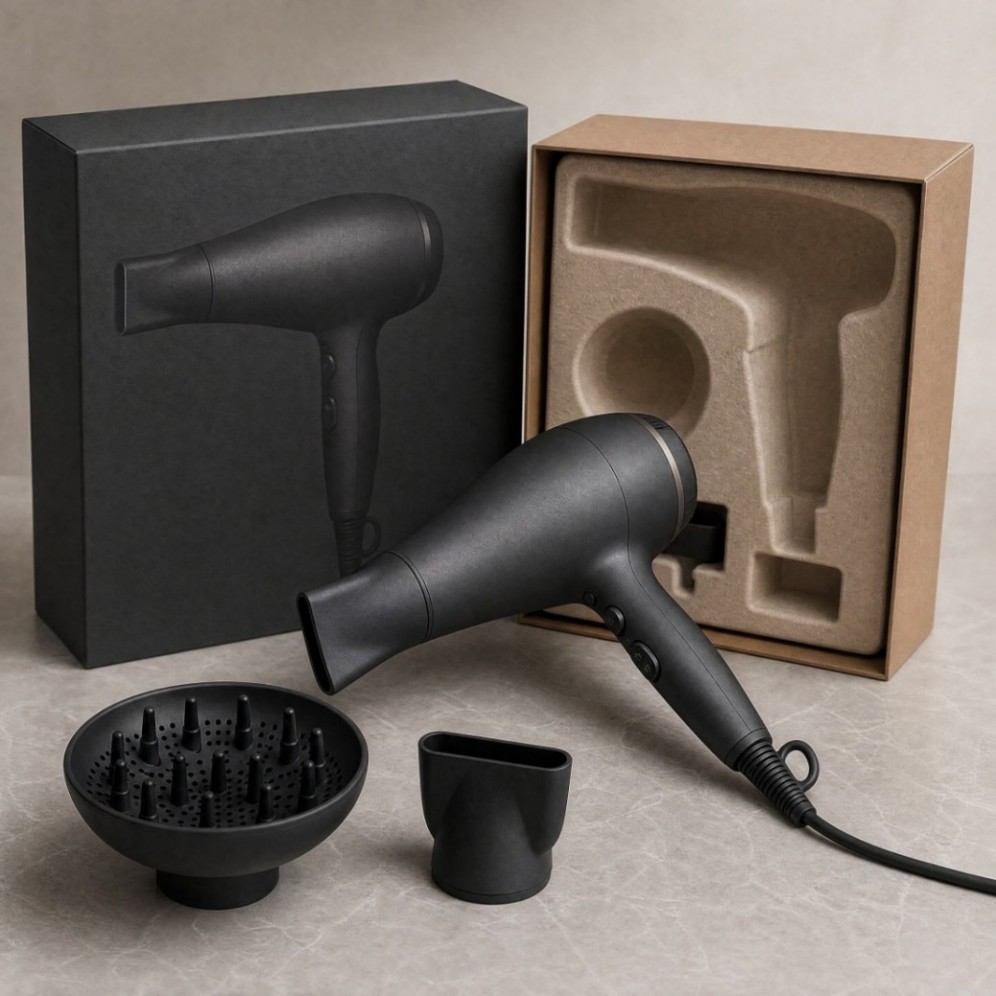
Choose the Right Hair Dryer Packaging Format
Baile supports several packaging formats because a salon dryer, premium gift set, ecommerce SKU and hotel project do not use the same box architecture. The starting format sets product protection, shelf presentation, accessory organization, labels and export packing. Baile develops each option around an existing model or a broader OEM/ODM project, then confirms the format before detailed dielines and artwork are released.
Retail Color Box
- Baile uses retail color boxes for standard, salon, travel and selected high-speed hair dryer programs.
- The front panel organizes product identity, approved selling points and required market information.
- Baile coordinates specifications, warnings, barcode position and fitted internal protection.
- The structure balances shelf presentation, practical dimensions, repeatable case packing and reliable handling through retail distribution, warehouse receiving and store replenishment operations.
Premium Gift Box
- Baile develops this format for premium dryers, launch collections, gifting programs and brand-led unboxing.
- Structures can organize the dryer, nozzle, diffuser, styling accessories and printed materials as one presentation set.
- Baile connects the opening method, insert layout, surface treatment and artwork with the actual product configuration.
- Compared with a folding color box, this format adds material, finishing, sampling and packing steps.
Ecommerce Shipping Pack
- Developed for DTC, Amazon/FBA and cross-border orders where transport handling and label clarity are central.
- Baile can coordinate the retail pack, protective insert, barcode or FNSKU label, warning label and outer shipping carton.
- Product and accessories remain separated to reduce movement and contact during delivery.
- Final construction and transport evaluation depend on product weight, accessory count, shipping route and customer requirements.
Accessory Kit Box
- Baile uses this format for multi-nozzle dryers, diffuser sets, styling kits, wall-mount accessories and expanded configurations.
- The insert assigns a defined position to the dryer, cord, plug, each attachment, manual and optional storage item.
- Baile uses the approved component list as the packing reference.
- Larger sets add box area, insert complexity, inspection points and freight volume, which Baile defines before sampling.
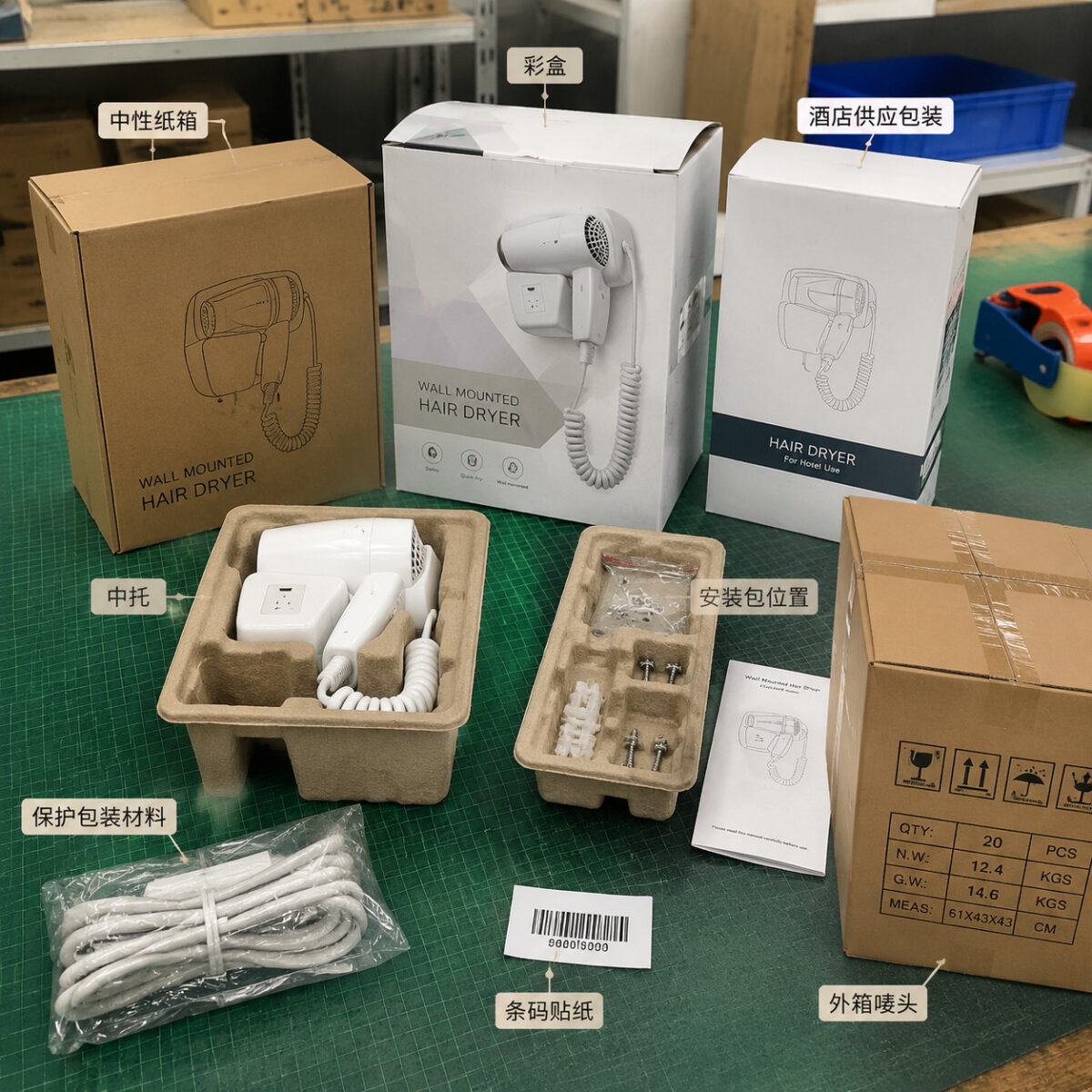
Hotel Project Pack
- Baile develops project packs for wall-mounted, travel or guest-room hair dryers supplied by batch rather than retail display.
- Baile can coordinate installation parts, screws, mounting instructions, safety information, batch labels and clear outer-carton identification.
- Packing can be organized around project distribution and accessory completeness.
- The final configuration follows the dryer model, mounting system, room allocation method, accessory count, batch plan and destination handling requirements.
Paper-Based Direction
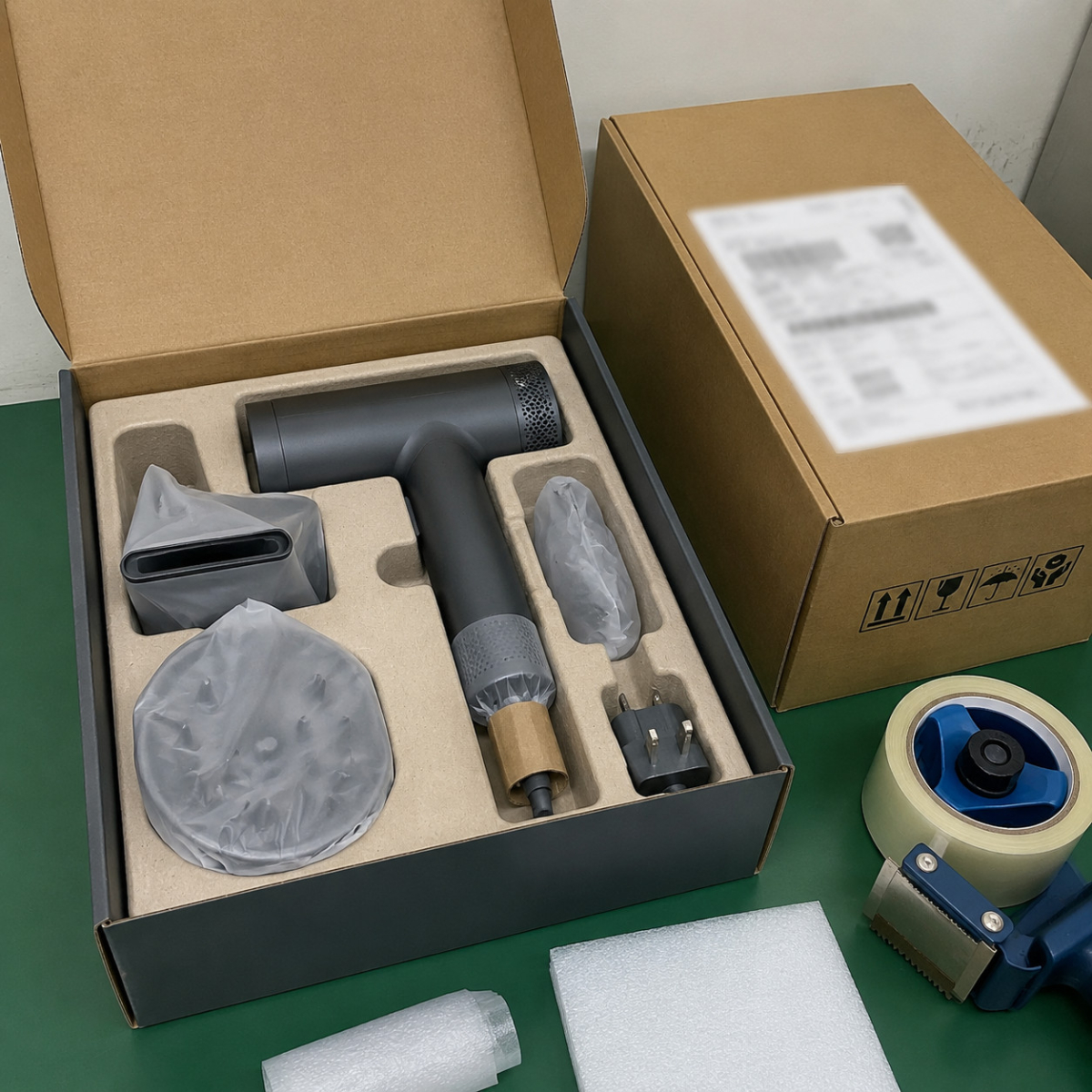
- Baile uses paper card, molded-pulp, corrugated or combined structures where the product and protection target allow.
- Baile compares product retention, accessory separation, surface contact, presentation and packing volume before selecting the route.
- Less-plastic directions remain project-specific rather than automatic environmental claims.
- Recyclability, certified sourcing or material composition is stated only when the selected material and supporting supplier documents confirm the exact project claim.
Control Every Custom Packaging Detail
Baile converts a packaging concept into eight controlled specifications. Brand, sourcing, compliance and quality teams can use the same inputs and approval records from structural development through bulk packing. Each control point identifies the customer input, Baile output and the commercial or technical factor it changes, preventing visual decisions from becoming disconnected from production requirements.
Box Structure
- Customer input: preferred format, product position and dimensional limits.
- Baile output: box structure, dimensions, opening route and dieline direction.
- Main impact: product fit, printed area, material use, outer-carton quantity and freight volume.
- Structural changes are approved before final artwork is released.
Insert Layout
- Customer input: final dryer model, plug, cord and complete accessory list.
- Baile output: retention points, accessory zones, removal sequence and insert construction.
- Main impact: movement control, scratch prevention, packing accuracy, box height and unboxing order.
- The layout is verified with the actual product configuration.
Material Route
- Customer input: protection priority, appearance target, restricted materials and cost position.
- Baile output: project options covering paper card, pulp, EVA, blister, foam, corrugated or combined protection.
- Main impact: cushioning, presentation, material usage, packing volume, MOQ and quotation.
- Final suitability is sample-based.
Print Finish
- Customer input: brand colors, artwork files and required surface effects.
- Baile output: printing and finishing route, color reference and approval sample.
- Main impact: appearance, sample rounds, production yield, unit cost and lead time.
- Options may include color printing, lamination, spot UV, foil or embossing where the project supports them.
Brand Layout
- Customer input: logo, product images, approved claims and brand guidelines.
- Baile output: controlled placement across the box, insert-facing areas and related printed materials.
- Main impact: hierarchy, readability, SKU recognition and visual consistency.
- Baile does not add unapproved performance or certification claims to artwork.
Manual Content
- Customer input: target countries, required languages and importer information.
- Baile output: manual size, placement and the approved print version linked to the product SKU.
- Main impact: packing space, language count, revision control and market documentation.
- Electrical and safety information must match the relevant model.
Barcode Labels
- Customer input: barcode data, SKU, FNSKU, customer material number and platform rules.
- Baile output: confirmed label size, location, print version and scanning checkpoint.
- Main impact: receiving, fulfillment, inventory identification and shipment release.
- Customer-owned codes remain subject to customer approval before production.
Export Cartons
- Customer input: shipment route, carton-mark data, packing quantity and handling needs.
- Baile output: carton structure direction, marks, labels and packing specification.
- Main impact: stacking, warehouse identification, gross/net weight records and distribution.
- Final carton construction follows product load and project transport requirements.
Engineer the Dryer and Insert Together
A hair dryer insert must control more than the outline of the main housing. Baile maps the handle, air inlet, outlet, controls, cord exit, plug, nozzles, diffuser and printed materials before defining support points and accessory zones. This product-first method reduces uncontrolled movement, surface contact, cable compression and missing-component risk while keeping removal, packing and carton utilization practical. The approved layout then becomes a reference for structural sampling, packing instructions and first-piece verification.

Map the Main Dryer Geometry
Baile starts with the actual dryer dimensions and its orientation inside the box.
- Support points: The housing and handle need stable contact areas that do not press fragile controls, decorative surfaces, air inlets or outlets.
- Clearance: Space around protrusions, switches and finish-sensitive zones prevents the insert from creating marks during packing and transport.
- Cord path: Cable length, cord exit and the required bend radius determine a separate route so the line is not sharply folded, trapped under the dryer or forced against a coated surface.
- Plug zone: US, EU, UK, AU and other plug configurations can change the required pocket size and overall pack height. A packaging version is linked to the corresponding electrical SKU.
- Handling: The dryer must be removable without pulling the cord or damaging the insert. The approved direction also supports a repeatable packing operation on the production line.
The result is a product-position drawing or fitted sample that defines orientation, contact points, clearance and line routing before decorative artwork becomes final.

Organize Accessories and Printed Parts
Accessories are treated as controlled packing components rather than loose additions.
- Nozzles and diffusers: Each attachment receives a defined location that limits collision with the dryer and makes the component count visible during packing.
- Styling kits: Multi-head or multi-accessory sets require a hierarchy for the main product, frequently used attachments and secondary items. This affects opening order and box area.
- Wall-mount projects: Brackets, screws and installation materials are separated and identified so they can be checked before shipment.
- Manuals and cards: Printed items need a flat, accessible position that does not cover labels or become damaged by product movement.
- Protection choice: Paper card, pulp, EVA, blister, foam or corrugated structures are compared against geometry, surface contact, presentation and project restrictions; none is treated as the universal default.
Baile verifies the complete pack with the intended dryer, plug and accessory combination. Any component change triggers a fit review before bulk packing.
Match Packaging to the Sales Channel
Baile links each packaging specification to how the hair dryer is stored, sold and delivered. Ecommerce packs prioritize transport handling and code accuracy; retail packs add shelf communication and display control; hotel projects require complete installation parts and batch identification. Baile confirms the channel, product data, labels and distribution inputs before releasing the structure, artwork and carton versions for that market.
| Sales Channel | Baile Packaging Route | Labels and Documents | Main Control | Project Input |
|---|---|---|---|---|
| Amazon / FBA | Fitted insert plus a shipping-pack route matched to fulfillment | FNSKU/SKU, barcode, warning, set and carton labels as required | Scannable codes, complete sets and protected sellable packs | Marketplace, SKU data, label files and shipment route |
| DTC / Gift | Presentation or retail box with separated product and accessories | Brand content, manual and order/SKU identification | Controlled unboxing, surface protection and practical parcel volume | Unboxing goal, carrier route, accessories and brand assets |
| Retail Chain | Color, display or gift box with a controlled front panel and case pack | Barcode, specifications, warnings, importer data and model-specific marks | Correct artwork, readable shelf information and carton consistency | Retailer guide, countries, size limits, case-pack and label data |
| Import / Wholesale | Unit packs and export cartons separated by market and SKU | Multilingual manuals, market labels, material numbers and carton marks | Correct versions, quantities and warehouse identification | Markets, languages, SKU map, cartons and forwarder instructions |
| Hotel / Project | Batch pack with separated mounting parts and instructions where applicable | Installation, safety, batch and project/carton identification | Complete hardware and clear site distribution | Dryer model, mounting kit, quantity and room allocation |
Compare Insert Materials and Protection Tradeoffs
Baile matches the insert to product geometry, surface sensitivity, accessory count, presentation, packing volume and transport requirements. The complete structure is sampled with the intended dryer, and Baile arranges transport evaluation when required. Paper sourcing, recycled content, recyclability or reduced-plastic claims are used only when the selected material documents support them. Final selection also covers packing-line handling and repeatable component placement.
| Material Route | Baile Application | Main Benefit | Main Limitation | Approval Evidence |
|---|---|---|---|---|
| Folded Paper Card | Defined product shapes and structured paper-based presentations | Folded locks and partitions can hold the dryer and accessories efficiently | Complex shapes or heavy accessories may need extra support | Fitted white sample and complete-pack review |
| Molded Pulp / Paper Tray | Shaped paper-based retention and reduced-plastic directions | Formed pockets with a distinct material appearance | Texture, tolerance, wall thickness and material documents need confirmation | Actual tray, product fit and material records |
| EVA Insert | Premium packs and accessory sets with precisely cut positions | Defined cavities and controlled presentation | Thickness, cost, surface contact and material restrictions | Material sample, fitted pack and appearance approval |
| Blister / Plastic Tray | Formed cavities and visible component separation | Repeatable retention with potentially compact geometry | Plastic use, tooling and surface contact may conflict with project goals | Formed sample and customer material approval |
| Foam Protection | Local cushioning and finish-sensitive contact zones | Separates surfaces and adds targeted cushioning | Extra layers can increase volume; density and appearance vary | Material sample and compression/fit review |
| Corrugated Combination | Ecommerce, export cartons and heavier sets | Partitions and pads reinforce the retail or project pack | Board grade, edge contact and carton utilization require confirmation | Structural sample and applicable transport evaluation |
Control Artwork, Labels and SKU Versions
Baile manages packaging artwork as a model- and market-linked production file. The rated voltage, power, plug, model number, warnings, language, barcode, importer information and applicable certification marks must agree across the nameplate, manual, retail box, labels and export carton. Separate markets or SKUs receive separate approvals, and a revised file replaces the earlier production version through a recorded confirmation point. This makes the approved order version visible to artwork, purchasing, packing and quality teams.
Build One Traceable SKU File Chain
Baile connects every printed component to the exact hair dryer configuration it accompanies.
- Product identity: Model number, rated voltage, power and plug direction establish the base SKU. Packaging cannot be approved independently of these details.
- Retail artwork: Product name, specifications, warnings, origin, importer information and brand claims are placed using the customer-approved source content.
- Manual version: Language set, safety information and model references are checked against the same SKU. A manual for one voltage or market is not treated as a universal insert.
- Codes and labels: Barcode, SKU, FNSKU, batch label and customer material number are assigned a defined file, size and position. Customer-owned data remains subject to customer approval.
- Outer carton: Carton marks, packing quantity, gross/net weight fields and destination information are linked to the unit-pack version and order requirements.
The approved file chain guides packing, inspection, repeat-order comparison and batch traceability from the dryer nameplate to the shipping carton.
Release Only the Approved Market Version
Baile uses approval points to stop outdated or mixed files from entering packing.
- Preflight check: Confirm the model, market, language, plug and code list before the artwork route is released.
- Artwork approval: Record the approved dieline and print file. Comments are closed against a named revision rather than exchanged as untracked screenshots.
- Physical verification: Review printed color, content placement, barcode readability, manual version and carton marks on the applicable sample or first piece.
- Change control: A change to voltage, plug, market, importer data, label or accessory list triggers review of every affected printed component.
- Production release: Packing uses the approved version associated with the order and SKU. First-piece and process checks compare physical materials with that reference.
Baile applies certification marks and compliance documents only to the relevant model and destination. The recorded release remains available for repeat-order review and traceability. Baile retains the approved revision as the production and inspection reference.
Move Through Seven Packaging Approval Gates
Baile advances custom hair dryer packaging through defined approval gates instead of sending artwork directly to bulk printing. Each gate converts a project input into a controlled output: the brief establishes the use case, product measurement fixes the physical basis, structure and artwork create reviewable files, samples verify the result, and the first production piece transfers the approved standard into mass packing. Responsibilities and revision points remain visible throughout the sequence.

Gates 1–4: Define Structure and Files
1. Project brief
- Input: dryer model, quantity, accessories, market, channel, packaging direction and target timing.
- Baile output: packaging scope, open decisions and sample route.
- Locked after approval: project boundary and responsible file list.
2. Product and accessory measurement
- Input: final dryer, plug, cord and complete component set.
- Baile output: placement, critical dimensions and packing orientation.
- Locked after approval: physical configuration used for structural design.
3. Box and dieline development
- Input: dimensional limits, display needs, material direction and carton plan.
- Baile output: box structure, insert direction and dieline.
- Locked after approval: structural file used for artwork and sampling.
4. Artwork and market files
- Input: logo, brand guidelines, approved claims, languages, codes and market data.
- Baile output: box, manual, label and carton artwork versions.
- Locked after approval: the files authorized for physical sampling.
Changes after a gate is closed return to the affected approval point so the structure and files remain synchronized.
Gates 5–7: Prove and Release the Pack
5. Structural and print samples
- A white or structural sample verifies dimensions, folding, product fit and accessory organization.
- A print sample verifies artwork position, color direction, text, codes and finishing result.
- Packaging samples are typically completed in 7–15 days, depending on structure, material, print process, file completeness and approval speed.
6. Complete-pack approval
- Baile packs the intended dryer, plug, attachments, manual and labels into the sampled structure.
- The review covers retention, contact points, component completeness, opening sequence, visible presentation and outer-carton relationship.
- The customer-approved sample and file set become the reference for production preparation.
7. First-piece production release
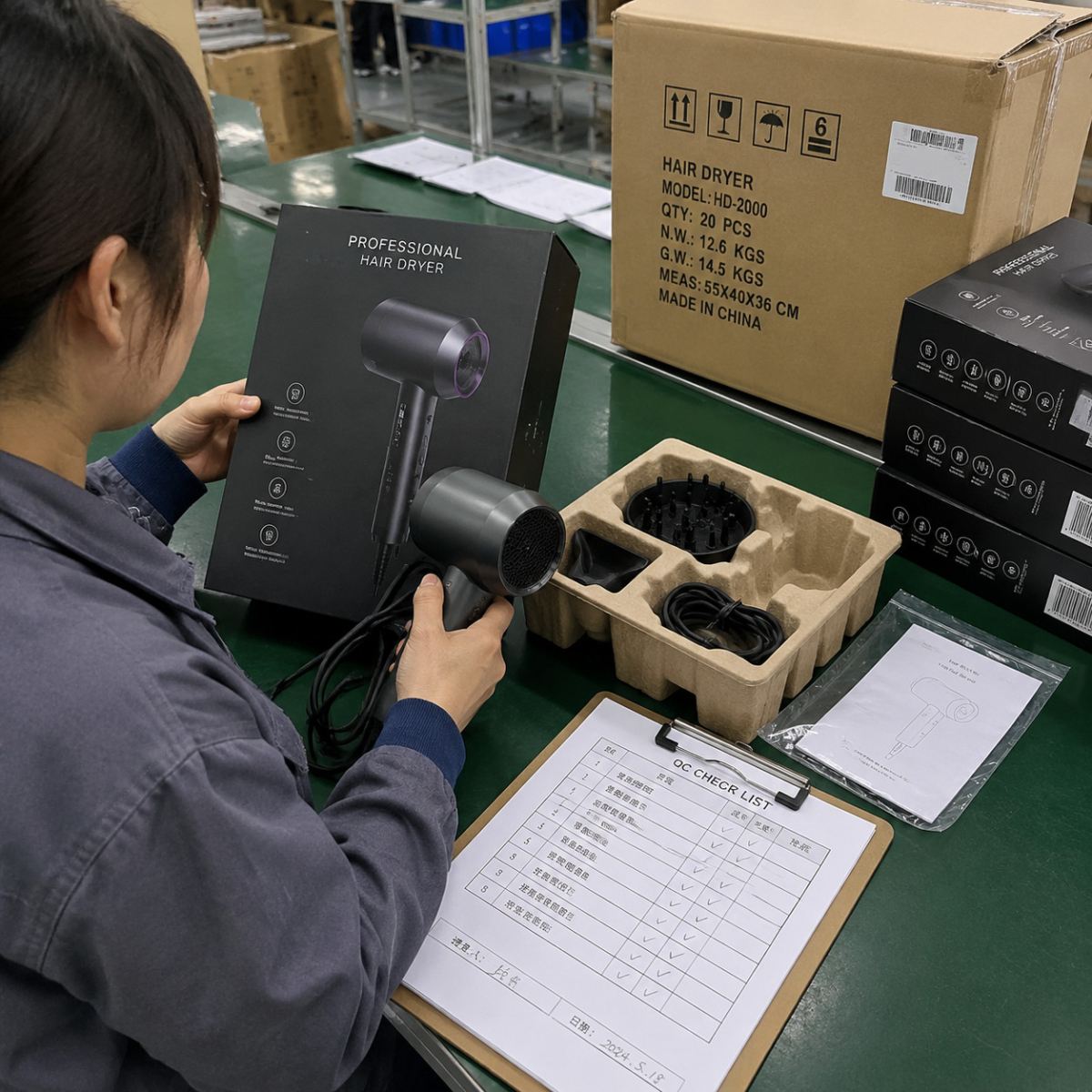
- Baile checks the first production packaging against the approved structure, print files, labels, manual, insert layout and packing quantity.
- Any mismatch is corrected before routine packing continues.
- Later changes are documented and reapproved where they affect the reference.
These gates separate design approval from bulk verification. After release, production checks confirm that packing follows the approved structure and files.
Verify Bulk Packing and Transport Protection
Baile transfers the approved packaging standard into production through incoming, first-piece, process and outgoing checks. The control plan covers printed materials, inserts, accessory completeness, manuals, labels, sealing and export cartons. Baile applies drop, vibration, stacking, AQL or third-party inspection only when agreed for the product, order and route. Each record is tied to the applicable project checkpoint.
| Control Point | Baile Check and Method | Timing | Project Record | Risk Controlled |
|---|---|---|---|---|
| Incoming Packaging | Compare boxes, inserts, manuals, labels and cartons with approved material, appearance and file versions | Before packing release | Incoming or material check record | Wrong material, defects or outdated files |
| First Piece | Pack one complete dryer and compare structure, artwork, labels, manual and carton marks with the approved reference | Production start or approved change | First-piece record and photos | Incorrect bulk packing standard |
| Process Packing | Check orientation, cord route, accessory count, manual, insert retention and component movement | During packing | Process or packing record | Missing parts, cable compression or movement |
| Barcode and Version | Compare model, language, SKU and label position; scan barcodes where applicable | Coded or multi-version orders | Scan result and version checklist | Receiving failure or mixed market versions |
| Appearance and Sealing | Check print position, color direction, damage, lamination, sealing and carton condition | Process and final inspection | Appearance and sealing record | Damaged presentation or weak packs |
| Transport Evaluation | Apply agreed drop, vibration or stacking method to the retail pack, insert and carton | Project-required development or order | Test record or third-party report | Transport damage or carton instability |
| Outgoing Inspection | Confirm quantities, marks, SKU, batch, dimensions, weights and shipment condition | Before release | Outgoing record, packing list or inspection report | Incorrect shipment or carton data |
Prepare MOQ, Timing and Cost Inputs
Baile custom packaging projects typically start from 1,000–2,000 units. Packaging samples typically take 7–15 days, and regular bulk production is about 35 days after product samples, packaging, orders and materials are confirmed. Final timing remains project-specific. Structure, materials, print finishing, SKU count, testing scope, quantity and approval speed determine the quotation and schedule. Complete product and market inputs reduce requoting and file revisions.
| Project Input | Baile Reference | Cost / Schedule Effect | Required Confirmation |
|---|---|---|---|
| Order Quantity | Custom packaging MOQ is typically 1,000–2,000 units | Sets the material, print and packing route | Quantity by model, market and packaging version |
| Dryer and Accessories | Existing models and OEM/ODM projects can include custom packaging | New shapes, plugs or accessories may require new dielines and inserts | Final model, dimensions, plug, cord and component list |
| Box and Insert | Color, gift, retail, ecommerce, project and export packs; paper, pulp, EVA, blister, foam or corrugated inserts | Structure, material, volume and presentation affect sampling and unit cost | Format, channel, material restrictions and size limits |
| Print and SKU Versions | Color printing, supported finishes, manuals, barcodes and SKU/FNSKU labels | More processes and versions add setup, separation and inspection points | Artwork, colors, languages, codes and quantity per version |
| Sample Timing | Packaging samples typically require 7–15 days | Complex structures, finishes or incomplete files can extend timing | Sample type, file status and approval owner |
| Bulk Timing | Regular production is about 35 days after sample, packaging, order and material confirmation | Late approvals, changes or added tests can move the schedule | Final approvals, order status, materials and ship date |
| Validation Scope | Drop, vibration, stacking, AQL or third-party inspection follows agreed requirements | Additional methods and reports affect cost and timing | Method, criteria, report and inspection party |
Custom Hair Dryer Packaging FAQ
Baile applies these answers to the selected dryer model, destination, channel and approved project files. MOQ, timing, materials, market versions and validation remain project-specific. The answers below state confirmed capabilities and the conditions that affect each packaging route. Baile links each answer to its relevant approval point and record.
Can Baile repackage an existing hair dryer model?
Yes. Baile can adapt boxes, inserts, manuals, labels and export cartons around an existing model. The final dryer, plug, cord and accessory list define the structure. A changed housing, plug or attachment triggers a fit and dieline review.
What files start structural packaging design?
Baile starts with the dryer model, dimensions or sample, plug, cord, accessories, channel and packaging direction. Photos or CAD support the first layout; the intended physical configuration verifies the fitted structure. Brand artwork is not required for structural development.
Who supplies packaging artwork and market text?
The brand supplies approved logos, images, claims, languages, importer details and barcode data. Baile coordinates dielines, print files, manuals, labels and carton marks. Baile does not add unsupported performance, certification or environmental claims.
Can we approve a white sample first?
Yes. A white sample verifies dimensions, folding, dryer fit, cord routing, insert retention and accessory layout before printing. A print sample verifies artwork position, color and finishing. Baile sets the sequence according to structural and visual complexity.
How long does packaging sampling take?
Custom packaging samples typically require 7–15 days. Structure, insert material, printing, finishing, file completeness and approval speed affect the schedule. Baile confirms the timing for the approved sample route.
What is the custom packaging MOQ?
Baile custom packaging projects typically require 1,000–2,000 units. Box structure, insert, printing, finishing and version count affect the final MOQ. Quantities are confirmed by model and packaging version.
Can Baile apply SKU or FNSKU labels?
Yes. Baile coordinates barcode, SKU, FNSKU, warning, customer-number and carton labels within the approved scope. The customer approves code data and platform requirements. Baile confirms each file, size, position and applicable scan check before release.
How are multiple market versions controlled?
Baile assigns a packaging version to each model, voltage, plug, language and market combination. The nameplate, box, manual, labels and carton marks stay linked to that SKU. Any change triggers review of all affected files.
Can Baile develop reduced-plastic packaging?
Baile can develop paper-card, molded-pulp, corrugated and combined structures where product fit and protection allow. Reduced-plastic, recycled-content, recyclable, certified-sourcing or compostable claims are used only when the selected material documents support them.
Which packaging tests can be arranged?
Baile can arrange drop, vibration, stacking, fit, appearance, barcode, AQL or third-party inspection requirements by project. The product, carton, route and customer program define the method, conditions, acceptance criteria and report.
Start Your Hair Dryer Project With BAILE
BAILE supports projects that begin with a specification sheet, reference model, product photo, existing sample, packaging artwork, private label request, or new market requirement. Clear information helps BAILE recommend a practical dryer route and reduce repeated clarification.
Project Brief Checklist:
- Hair dryer line, reference model, product photo, or sample.
- Target market, sales channel, estimated quantity, and order plan.
- Plug, voltage, frequency, rated power, motor, heater, airflow, temperature, and function needs.
- Logo, color, finish, label, manual, packaging, barcode, and carton mark requirements.
- Nozzle, diffuser, comb, stand, bracket, or accessory list.
- Certification route, sample purpose, destination, shipping term, launch timeline, and target price if available.